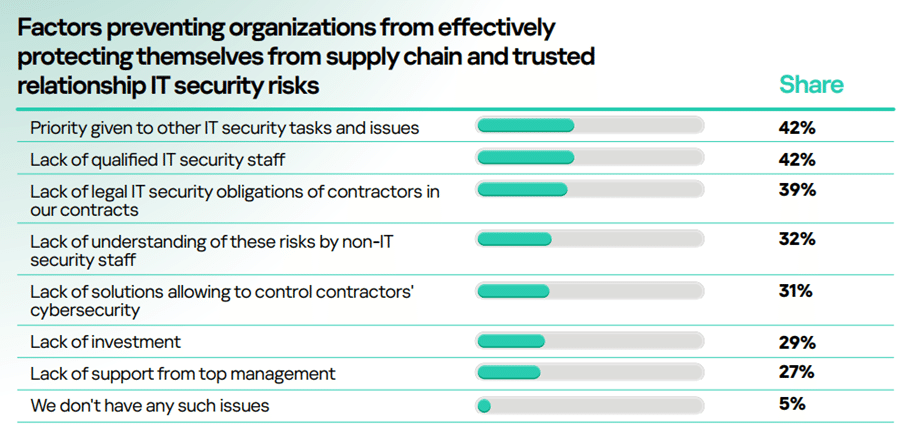
A new global Kaspersky study has identified the lack of qualified IT security workers and the need for global organizations to prioritize various security tasks to mitigate the risk of supply chain and trusted relationship attacks. Both factors are cited by nearly half (42%) of the respondents.
Kaspersky’s recent study[1] on supply chain and trusted relationship risks showed that supply chain attacks have emerged as a top threat for businesses, with every third organization hit by such an attack over the past year. The severity and frequency of supply chain attacks necessitates uncovering the key reasons preventing them from addressing the risks successfully.
According to the survey, one of the key barriers to reducing supply chain and trusted relationship risks is the lack of a qualified workforce. This shortage leaves organizations without the capacity to consistently access and monitor possible third-party vulnerabilities across their ecosystems. The need for security professionals to effectively tackle such risks is especially high in Vietnam, the UAE, Mexico, and Spain.
Among other primary obstacles, respondents noted the need to juggle multiple cybersecurity priorities, especially prominent for respondents in India, Vietnam, Singapore and Egypt. This reflects the fact that security teams are stretched across too many tasks at once, which might leave supply chain threats unaddressed.
Beyond resource constraints, respondents also point to structural issues: 39% say their contracts lack clear IT security obligations for contractors, with contractual gaps being especially prominent in Vietnam, Turkey, Spain and Mexico. Further 32% note that non‑IT security staff often do not fully understand these risks.
Globally, according to the survey, an overwhelming 85% of businesses admit their organizations need to upgrade protection against supply chain and trusted relationship risks, with only 15% of enterprises considering their current security measures effective. This confidence plummets further in key economies like Germany (6%), Turkey (7%), Italy (8%), Brazil (8%), Russia (8%), and Saudi Arabia (9%).
At the same time, the results of the survey showed that current mitigation practices for third-party risks remain fragmented, with no way of protection getting more than 40% of current adopters. Even the most common protective measure, two-factor authentication, is used by only 38% of respondents.
In addition, only 35% of organizations conduct regular reviews of contractors’ cybersecurity postures. As a result, nearly two thirds of businesses lack ongoing visibility into the security of their partners, leaving them exposed to evolving vulnerabilities across their ecosystems.
It’s noteworthy, that companies that have already experienced supply chain and trusted relationship attacks, tend to adopt stronger security habits. Those hit by supply chain incidents are more likely to request penetration test results (56%), while victims of trusted relationship breaches prioritize checks on compliance with industry standards (56%) and their contractors’ own supply chain policies (53%).
“When security teams are overstretched, understaffed and have to prioritize urgent tasks over long term resilience priorities, organizations are left exposed to threats that can move silently through their provider ecosystem. To break this cycle, the industry needs to adopt more unified and consistent mitigation strategies, from standardized contractor assessments to stronger cross‑team awareness. Supply chain security should become a shared, enforceable responsibility across the entire business network”, comments Sergey Soldatov, Head of Security Operations Center at Kaspersky.
Only by implementing preventive measures across the organization and approaching partnerships with suppliers and contractors strategically can companies reduce supply chain risks and ensure the resilience of their business.
For mitigating such risks, Kaspersky recommends the following:
- Adopt managed security services. For organizations lacking dedicated cybersecurity resources, the best solution is to resort to outsourcing. Use such services as Kaspersky Managed Detection and Response (MDR) and / or Incident Response, which cover the entire incident management cycle – from threat identification to continuous protection and remediation.
- Invest in additional cybersecurity courses. Enhance the cybersecurity knowledge of your employees with practically-oriented self-guided or live Kaspersky Cybersecurity Training. These educational programs help security professionals advance their hard skills and protect companies against sophisticated attacks.
- Thoroughly evaluate suppliers before entering a deal. Check their cybersecurity policies, information about past incidents and compliance with industry security standards. For software and cloud services, it’s also recommended to review vulnerability data and penetration test results.
- Implement contractual security requirements. Contracts with suppliers should include specific information security requirements, such as regular security audits, compliance with your organization’s relevant security policies, and incident notification protocols.
- Collaborate with suppliers on security issues. Strengthen protection on both sides and make it a shared priority.
More recommendations along with other findings on supply chain risks mitigation are available via the link.
[1] For the report, Kaspersky internal market research center commissioned a survey, questioning 1,714 technical experts, ranking from C-level employees and vice-presidents to team leads and senior specialists from enterprises with more than 500 employees. The study covered 16 countries, including Germany, Spain, Italy, Brazil, Mexico, Colombia, Singapore, Vietnam, China, India, Indonesia, Saudi Arabia, Turkey, Egypt, the United Arab Emirates and Russia.


